Before the Sun, the Ovens: Why Arab American Bakeries Became the Block's Living Room
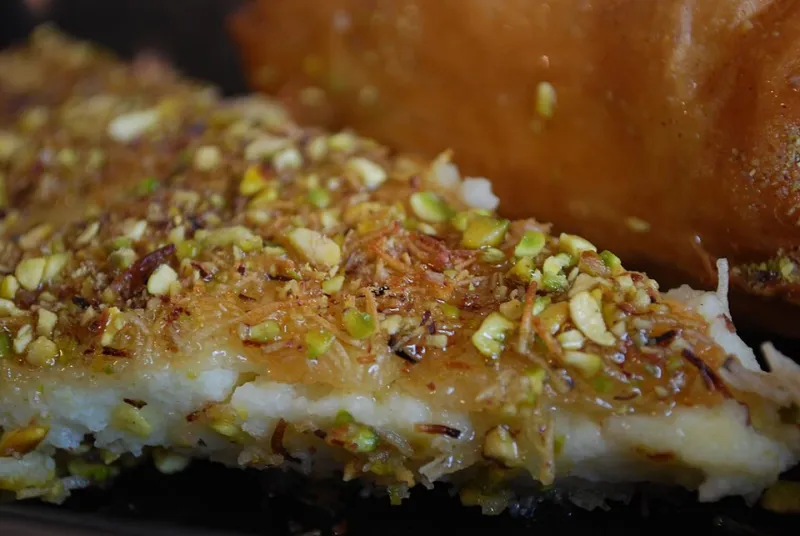
Photo: avlxyz, CC BY-SA 2.0, via Wikimedia Commons
The lights come on in the back of the shop around 5:40. By 6:05, the first tray of mana'eesh is out of the oven, the za'atar has reached the sidewalk, and the same four men are in the same corner seats arguing about a soccer match that ended three days ago.
This particular shop sits on Ford Road in Dearborn, Michigan, but you can find a version of it in Anaheim's Little Arabia, in Bridgeview outside Chicago, on Kennedy Boulevard in Jersey City, and along Hillcroft in Houston. The menus change. The choreography doesn't.
The first hour belongs to the regulars
Abu Nabil is 71 and retired from a stamping plant. He arrives at 6:15, orders the same thing — small coffee, one cheese pie, extra napkins he never uses — and stays until his wife calls asking where he's gotten to. He is not really here for breakfast.
“At home, I sit and I think too much,” he says, tapping the table. “Here, somebody is always talking. Even if I don't like what they say, it's better than the television.”
The morning shift at these bakeries is a rotating cast of retirees, night-shift nurses coming off duty, delivery drivers killing forty minutes before a route, and fathers who drop the kids at school and then take the long way home. Nobody has to make an appointment. Nobody has to buy much. A $2.50 coffee buys three hours of belonging, which is a better hourly rate than almost anywhere else in America.
A waiting room with za'atar on the table
By 8 a.m., the room has turned over. Now it's mothers with strollers, a college student studying for a licensing exam in the corner, and a man named Fadi who has been in the country for eleven weeks and is learning that you can ask almost anything here if you bring a plate of something to share.
The owner of a bakery in Bridgeview keeps a plastic chair by the register specifically for this. “People come in to ask about an apartment, a job, a doctor who speaks Arabic, where to get a car inspected without getting robbed,” he says. “I'm not a social worker. But if I don't know, the guy at table three knows.”
That's the thing about a third place: it isn't designed. It accretes. A bakery has three qualities that make it unusually good at this — it's cheap, it opens early, and it has no reason to hurry you out. You cannot loiter in a bank. You can absolutely loiter over a second cup of tea while the trays keep coming.
The bulletin board by the register
Look to the right of the cash register at almost any of these shops and you'll find a corkboard that has somehow survived the smartphone era. Arabic lessons on Saturdays. A room for rent, girls only, no smoking. A tutoring ad with a phone number and twelve tear-off tabs, three of them gone. A notice for a memorial gathering. A used Honda, cash only.
“Everybody says the group chat killed the corkboard,” says Rana, who manages her family's shop in Jersey City. “No. The group chat is for people who already know each other. The board is for the ones who just got here.”
She has a point. A WhatsApp group requires a network. A piece of paper taped to a wall requires only that you walk in and look.
The math behind a $3 pastry
Here is where the warmth meets the spreadsheet. Bakery margins are thin in the best of times — flour, butter, pistachios, sesame, gas for the ovens, and payroll for people willing to start at 4 a.m. Pistachio prices have been volatile for years, and a bad harvest overseas shows up on a baklava tray in Detroit within months.
Commercial rent is the bigger squeeze. Several longtime shops in rapidly redeveloping corridors have watched their leases double, or been bought out by developers who want the corner for a mixed-use building with a coffee chain on the ground floor.
And there is the succession problem. “My father worked seven days,” Rana says. “I love this place. I am not working seven days.” Her brother is a pharmacist. Her sister is in logistics. The shop either hires a manager, downsizes the menu, or closes.
The ones holding on tend to have found a second engine: wholesale trays for local restaurants, catering for weddings and wakes, packaged baklava that ships nationwide, a small grocery aisle bolted onto the front. The bakery survives because it stopped being only a bakery.
What keeps the lights on
You could read all of this as a story about decline. It isn't quite. Walk into a shop on a Saturday morning in late November and the line is out the door — families buying tray after tray for a friend's gathering, a man in a suit picking up forty pieces for an office party, a kid counting out quarters for one piece of harissa.
The owner in Bridgeview puts it plainly. “I don't need people to feel sorry for me. I need them to come in on Tuesday. Tuesday is the hard day.”
That's the whole ask, really. Not nostalgia — Tuesday. The corner table doesn't stay warm on its own, and the argument about the soccer match doesn't referee itself. Somebody has to be there at 6 a.m., and somebody has to be there to meet them.