She Shows Up in Hijab and She Shows Up to Win: Muslim Women Athletes Are Changing the Game
Ibtihaj Muhammad didn't just make the US Olympic fencing team. She made history as the first American athlete to compete in the Olympics while wearing hijab — and then she won a bronze medal at Rio 2016 and made sure nobody could reduce her to a symbol without also acknowledging the sword in her hand.
That combination — unapologetic identity and undeniable excellence — has become something of a template for a growing cohort of Muslim and Arab American women athletes who are competing at elite levels across a wide range of sports. They're not asking for permission to belong. They're showing up, performing, and letting the results speak.
More Than a Moment
It would be easy to frame Muslim women in American sports as a recent phenomenon, a product of increased visibility and social media reach. But the history runs deeper than the highlight clips.
Arab and Muslim American women have been competing in organized sports in the US for decades, often without the institutional support, media coverage, or appropriate gear that their non-Muslim counterparts took for granted. What's changed is not the athletes — it's the infrastructure around them beginning, slowly, to catch up.
"When I started running in high school, there was no modest athletic wear that was actually designed for performance," says Fatima Al-Rashid, a long-distance runner from Dearborn, Michigan, who competed at the Division I collegiate level and now coaches a community track program. "I was wearing layers that weren't breathable, that weren't built for speed. I was competing in spite of my gear, not because of it."
That experience — adapting, improvising, competing anyway — is something many Muslim women athletes share. And it's part of what makes their achievements particularly worth noting: they were often doing it with less.
The Gear Revolution
The past decade has seen a genuine shift in the athletic apparel industry, driven in no small part by Muslim women athletes and the communities that support them. Nike's Pro Hijab, launched in 2017, was a watershed moment — a major global brand formally acknowledging that Muslim women were a market worth designing for, not just tolerating.
But the real innovation has often come from smaller, community-rooted brands. Designers and entrepreneurs within Muslim American communities have been developing performance-grade modest athletic wear for years, building companies out of lived frustration with what the mainstream market wasn't offering.
"I couldn't find a swimsuit that let me compete and cover," says Zaynab Osman, a competitive swimmer from Houston who now advocates for inclusive aquatic programs in her city. "So I started making my own. That turned into a small business. That business now outfits competitive swimmers at three different high schools. It happened because the need was real and nobody else was meeting it."
The modest athletic wear market is now estimated to be worth hundreds of millions of dollars globally, and the quality has evolved dramatically. Moisture-wicking hijabs, full-coverage competition swimsuits, and modest uniforms that meet the technical requirements of various sports governing bodies are increasingly available — though advocates say there's still significant work to do at the institutional level, where uniform rules can still create barriers for observant athletes.
Fighting for the Right to Compete
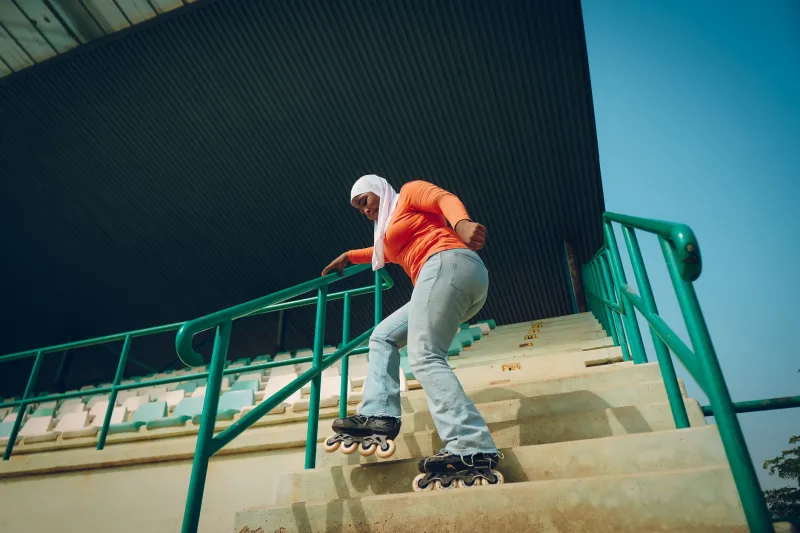
Uniform and dress code regulations have been one of the most concrete battlegrounds for Muslim women athletes. Basketball players have fought for the right to wear hijab on court. Wrestlers have navigated inconsistent state association rules about head coverings. Soccer players at various levels have dealt with referees who weren't familiar with updated FIFA regulations permitting hijab.
"The rules have gotten better, but enforcement is still inconsistent," says Coach Amira Hassan, who runs a girls' soccer program in northern Virginia and has been advocating for clear, consistent hijab accommodation policies in youth sports for nearly a decade. "I've had referees stop our games because they weren't aware that the rules had changed. That's a girl standing on a field being told her presence is a problem. That has consequences."
The psychological toll of those moments — of being questioned, stopped, singled out — is something athletes and coaches talk about with a weariness that comes from repetition. But they also talk about resilience, about the particular strength that comes from having had to fight for space that others occupy without thinking.
The Girls Who Are Watching
Ask any Muslim woman athlete about her motivation and the conversation will eventually turn to the girls who are watching. The visibility question — who gets to see themselves represented in sports — is not abstract for communities that have been largely invisible in mainstream American athletic culture.
"I coach girls who have never seen a Muslim woman play basketball on TV," says Nour Khalil, a former collegiate basketball player who now coaches at a community center in Chicago. "When I show them clips of players like Bilqis Abdul-Qaadir, who played Division I ball and went overseas professionally, something shifts. They start to believe it's possible. That's not a small thing."
Bilqis Abdul-Qaadir, who graduated as the all-time leading scorer in Massachusetts high school basketball history — boys or girls — is one of several Muslim American women athletes whose stories have become touchstones for younger generations. Ibtihaj Muhammad, fencer. Dalilah Muhammad, 400-meter hurdles world record holder. Khatuna Lorig, archer and five-time Olympian. These names are being passed down in Muslim American households like the names of champions have always been passed down — as evidence of what's possible.
Competing on Their Own Terms
What strikes you when you talk to Muslim women athletes across different sports and different backgrounds is the consistency of a particular refrain: they are not interested in being inspiration porn. They don't want to be celebrated primarily for their identity. They want to be evaluated on their performance.
"I want to be known as a good wrestler, full stop," says Mariam Suleiman, a high school wrestler in New Jersey who is currently ranked in her weight class at the state level. "The hijab is part of who I am. It's not the story. The story is that I work harder than almost anyone in my gym and I'm winning matches. That's the story."
She's right, of course. And the best thing American sports culture can do — the thing that would actually honor what these athletes are building — is to let the scoreboard do the talking.
Because they are winning. And they have been for a long time.