My Mom's Recipes Don't Have Measurements — And That's Where I Had to Start
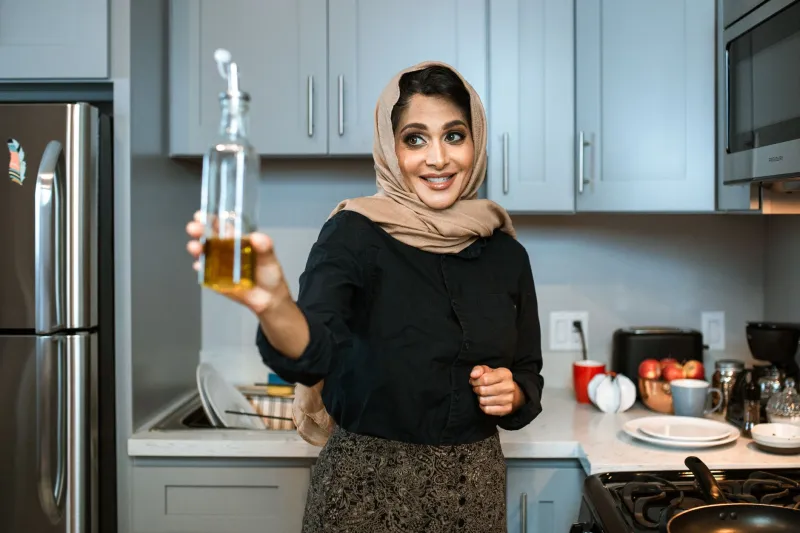
The first time I tried to make my mother's mujaddara on my own, I called her three times in forty minutes. The first call was about the lentils. The second was about the onions — specifically, how black is too black before they cross from crispy to ruined. The third call was just me, standing in my Brooklyn apartment, holding a wooden spoon and asking her what "enough cumin" meant in actual teaspoons.
She laughed at me. Lovingly, but still.
This is a story a lot of us know. Second-generation Arab Americans grew up watching their parents cook from memory, from instinct, from a kind of embodied knowledge that never got written down because it didn't need to be — until suddenly it did, because we moved out and moved away and found ourselves in cities far from home, craving something that couldn't be approximated by any restaurant, no matter how good.
The Kitchen as Cultural Archive
Food memory is its own kind of inheritance. For Arab American families, the kitchen has historically been one of the most reliable places where culture survived the immigration process intact. Language fades over generations. Religious practice adapts. Clothing changes. But the recipe for kibbeh — the specific way your grandmother layered the bulgur, the particular ratio of cinnamon to allspice — that tends to hold.
"My mom's cooking is basically the most Palestinian thing about our house," says Hana Awad, a 28-year-old food writer based in Chicago whose newsletter, Sofreh, documents her ongoing project of reconstructing her family's recipes. "We spoke English at home, we watched American TV, I went to public school. But dinner was Palestinian. Dinner was the thing that reminded us what we were."
For Hana, learning to cook her mother's food as an adult wasn't just a practical skill — it was an act of cultural preservation with a deadline. "My mom is in her 60s. My grandmother is gone. If I don't learn this now, it's gone. That's a weight I feel every time I open my notebook in her kitchen."
The Authenticity Trap
Here's where it gets complicated, though. Because the second generation doesn't just want to replicate what their parents made. They also want to cook the food they actually eat — the tacos and pasta and stir-fry that are equally part of their culinary identity. And when those two things collide, the authenticity police tend to show up.
The authenticity debate in diaspora food communities is exhausting, and most young Arab Americans will tell you so without being asked. There's pressure from older generations to preserve traditional recipes unchanged. There's pressure from the broader food media world, which tends to treat any cultural cuisine as a monolith with a fixed set of rules. And there's internal pressure — the feeling that adapting your grandmother's recipe is somehow a betrayal of something sacred.
"I made a shakshuka with feta and sun-dried tomatoes once and posted it online," says Rami Haddad, a home cook in Houston who runs a small cooking account on Instagram. "The responses were wild. Half the comments were Arab people saying that's not real shakshuka. The other half were food bloggers telling me it was genius. I was just trying to use what I had in my fridge."
The irony, as many food historians will point out, is that the dishes we treat as fixed and traditional were themselves the result of constant adaptation. Tomatoes aren't native to the Middle East. Chili peppers traveled from the Americas. The "authentic" version of almost any dish is a snapshot of a particular moment in an ongoing process of change.
Cooking Between Two Worlds
What's emerging from the second-generation Arab American kitchen isn't fusion in the watered-down, 1990s sense of the word. It's something more intentional — a kind of bilingual cooking that speaks both languages fluently and chooses when to mix them.
Sara Nasser, a food stylist and recipe developer in Los Angeles whose parents immigrated from Egypt, describes her cooking as "contextual." "When my family comes over, I make my mom's recipes as close to hers as I can. When I'm cooking for myself or my friends, I play. I'll use tahini in a Caesar dressing. I'll make a lamb ragu with ras el hanout. Those aren't the same dish, and they're both mine."
This contextual fluency — knowing when to hold close to tradition and when to riff — is something that takes years to develop, and it's deeply personal. For some, the act of modifying a family recipe feels liberating. For others, it still carries a faint guilt that no amount of cultural analysis can fully dissolve.
"I made my baba's rice pudding once with coconut milk because I was out of regular milk," admits Dina Khalil, a nurse and home cook in Dearborn, Michigan. "It was actually really good. But I didn't tell him for six months."
Writing It Down
One of the most meaningful things happening in second-generation Arab American food culture right now is the documentation project — the slow, often emotional work of sitting with parents and grandparents and actually recording what they do in the kitchen.
Hana Awad has been doing this for three years. She films her mother cooking, then goes home and tries to replicate it, noting every adjustment. "My mom will say 'a handful of this' and I'll measure what's in her hand and write it down. It's not her recipe anymore, exactly. It's a translation. But it's the closest I can get."
That translation work — honoring the original while making it legible to a new context — might be the most accurate description of what second-generation Arab Americans are doing in kitchens across this country. They're not abandoning their parents' food. They're not replacing it with something entirely new. They're building a bridge between two tables, and learning to eat comfortably at both.
The mujaddara, for what it's worth, came out well on the fourth try. I still called my mom. But this time it was just to tell her it was good.